

Written by the MindCore Studios engineering team. We design and build AI systems for startups and growing businesses. This is our read on Jev, a new model that's drawing a lot of attention, and on where it fits in the kinds of systems we build for clients.
What Is Jev?
Jev is a new AI model from Typesafe, a company co-founded by one of the people behind ChatGPT. Its pitch is simple: it runs many times faster and costs many times less than today's frontier models. In early public demos, answers come back in well under a second.
The pricing is unusual too. At launch, Typesafe charges only for input tokens, the prompt you send, at around four cents per million. Output is free. By most published comparisons that works out to more than 20 times cheaper than a top-tier model like Fable 5.1. Pricing this new tends to change, so check the current rate card before you plan a budget around it.
Why It's So Fast: Only Three Kinds of Answer
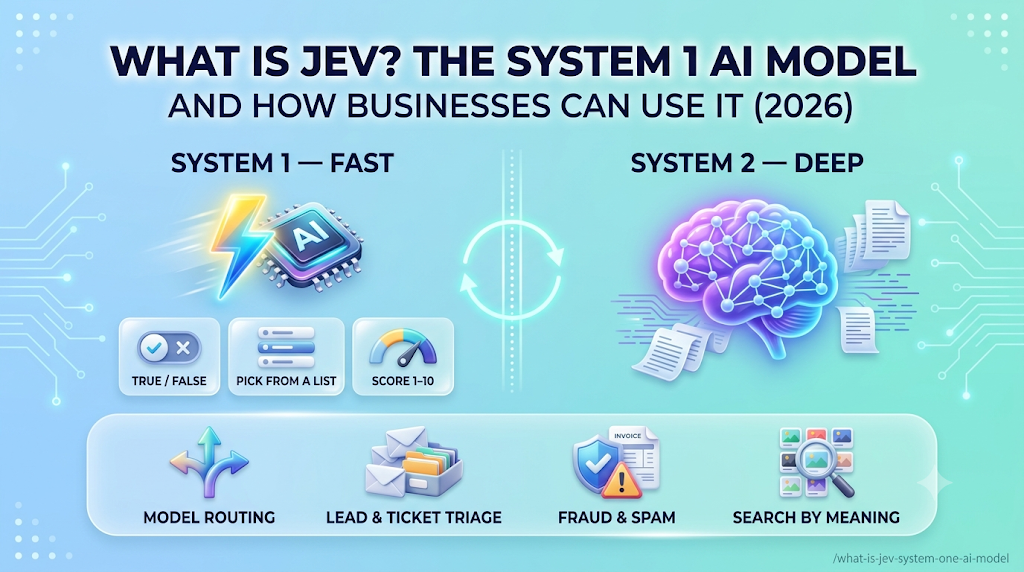
Jev can't write you an essay. Every answer takes one of three forms:
- Binary: is this statement true or false?
- Selection: which option from this menu fits best?
- Scale: where does this land on a range, say 1 to 10?
That looks like a big limitation, and it is. It's also the reason Jev is useful. A huge share of real business decisions are exactly this shape. Is this email a lead? Which department should get this ticket? How likely is this invoice to be fraud? You don't need a paragraph back for any of those. You need a fast, cheap, consistent decision.
System 1 vs. System 2 Models
Typesafe says Jev isn't a large language model at all. It calls Jev a "System 1" model and puts LLMs like Fable, Astra and Claude in the "System 2" camp. The terms come from Daniel Kahneman's Thinking, Fast and Slow. System 1 is fast, intuitive judgment. System 2 is slow, deliberate reasoning.
| System 1 (Jev) | System 2 (LLMs like Claude) | |
|---|---|---|
| Output | A classification: yes/no, a choice, or a score | Free-form text, code, plans |
| How it answers | One snap decision | Word by word, often with reasoning |
| Speed | Sub-second | Seconds to minutes |
| Cost | Fractions of a cent at volume | Adds up quickly at volume |
| Best at | Triage, routing, filtering, scoring | Writing, reasoning, multi-step work |
The practical takeaway: don't pick one over the other. The strongest systems will use both. Jev makes the thousands of small, fast calls, and an LLM handles the work that actually needs reasoning or writing.
Getting Access
Jev launched behind a waitlist, and Typesafe has since opened it to everyone. You can sign up with Typesafe directly for an API key, or use it through OpenRouter, which tends to add new models quickly and lets you keep one integration across providers. Most agent tools, Claude Code included, can be connected with a short setup prompt once you have a key.
Level 1: Faster, Cheaper Agents
The first win is inside the AI tools your team already uses. Two patterns stand out.
Automatic model routing
Running your most powerful model on every task burns money. Plenty of work, like finding a file or renaming a variable, is handled just as well by a small model such as Haiku or Sonnet. Until now, choosing the model has usually been the user's job, so it rarely happens. Jev can make that call for each task: given the request, choose a model from the list. In one published test of 12 mixed prompts, routing through Jev cut costs by about 70% compared with sending everything to Fable 5.1, because nine of the 12 tasks never needed the top model.
If you try this, make it easy to switch on and off, for example with a slash command, and check output quality on your own work before you trust the savings.
Instant skill lookup
Teams that give agents large libraries of skills or tools run into a quieter cost: the agent spends time and tokens working out which one to load. Framed as a selection problem, with the task as input and the skill list as the menu, Jev can pick the right skill almost instantly. In one demo against a library of about 145 skills, Jev found the right one across 14 tests in roughly 5 seconds in total. Opus 5 took about 30.
Level 2: High-Volume Business Automation
This is where we think Jev matters most for businesses. Any process where a lot of items arrive and each one needs a quick decision is a good candidate. Picture an inbox of inbound emails. Jev can label each one as a warm lead, a cold lead or not a lead in under a second for the whole batch, at a small fraction of what Haiku or Fable would cost for the same job.
The same pattern shows up across industries:
- Invoice fraud screening: flag suspicious invoices before they're paid
- Spam and abuse detection: filter messages, sign-ups or form submissions
- Community moderation: route posts to approve, review or remove
- Refund requests: sort high volumes by type or urgency
- Support triage: rank tickets by urgency and send them to the right team
- Churn risk: score subscription customers on how likely they are to leave
A useful exercise: list what your business receives in volume and the question you ask about each item. If the answer is yes/no, a category or a score, you probably have a Jev-shaped automation waiting. Where an item needs a written reply, let Jev triage and hand only the items that need it to an LLM.
Level 3: Features That Weren't Worth Building Before
When a classification costs almost nothing and returns instantly, features that used to be too slow or too expensive start to make sense.
- Search by meaning: a media library can find every image related to a topic, not just files with that word in the name.
- Page cleanup: Unclutter, a Chrome extension built on Jev, classifies each element on a web page and hides the ads, cookie banners and other clutter with one toggle.
If your users spend a lot of time searching, filtering or sorting, test whether a System 1 model improves that experience at a cost you can carry at scale.
Where Jev Isn't the Right Tool
- Anything that needs a written answer, such as drafting replies, summaries or code
- Multi-step reasoning where the path to the answer matters
- Decisions where the options can't be listed ahead of time
- High-stakes calls without a human or a second model checking edge cases
As with any new model, test Jev on your own data before you rely on it. A classifier that's right 95% of the time can be excellent for triage and unacceptable for final approval of payments.
Frequently Asked Questions
What is Jev?
Jev is an AI model from Typesafe that only classifies. It answers true or false, picks from a list of options, or gives a score on a scale. That narrow focus makes it much faster and cheaper than general-purpose LLMs.
Is Jev a large language model?
No. Typesafe calls it a System 1 model, built for fast judgments. LLMs like Claude or Fable are System 2 models that generate text word by word and can reason through complex problems.
How much does Jev cost?
At launch, Jev charges only for input tokens, at about four cents per million, and output is free. Check Typesafe's current pricing before you plan around it.
Can Jev replace Claude or other LLMs?
No. It's a complement, not a replacement. Use Jev for the fast routing, filtering and scoring decisions, and an LLM for work that needs writing or reasoning.
How do I access Jev?
Sign up with Typesafe directly for an API key, or use Jev through OpenRouter. Both work with common agent tools such as Claude Code.
What business processes are best suited to Jev?
High-volume processes where each item needs a quick decision: lead qualification, support triage, spam and fraud detection, content moderation, refund sorting and churn scoring.