
Written by the MindCore Studios engineering team practitioners who design, build, and ship custom software, AI systems, and MVPs for startups and growing businesses. This checklist is based on patterns we've seen firsthand across dozens of client engagements, including projects we've inherited after another vendor's contract fell apart.
Why This Decision Deserves More Than a Quick Google Search
Choosing a software development partner is closer to hiring a co-founder than picking a vendor. The team you choose will shape your product's architecture, your timeline, and if things go wrong how much technical debt you inherit down the line.
We've sat on both sides of this decision: as the team being evaluated, and as the team called in to rescue a project after the wrong partner was chosen. The failure pattern is almost always the same. It's rarely a lack of coding skill. It's a mismatch that was visible early on, in the sales process, but got waved away because the timeline looked fast or the price looked good.
This checklist is the set of questions we'd want a founder to ask us and the answers that should make you walk away if they're missing.
How We Put This Checklist Together
This isn't a generic listicle. Each item below maps to a specific failure mode we've either experienced directly or helped a client recover from scope disputes from vague pricing, stalled projects from unrealistic timelines, and rebuilds triggered by unclear code ownership. Where relevant, we've noted what a good answer sounds like versus a vague one, so you have something concrete to listen for in a sales call, not just a topic to bring up.
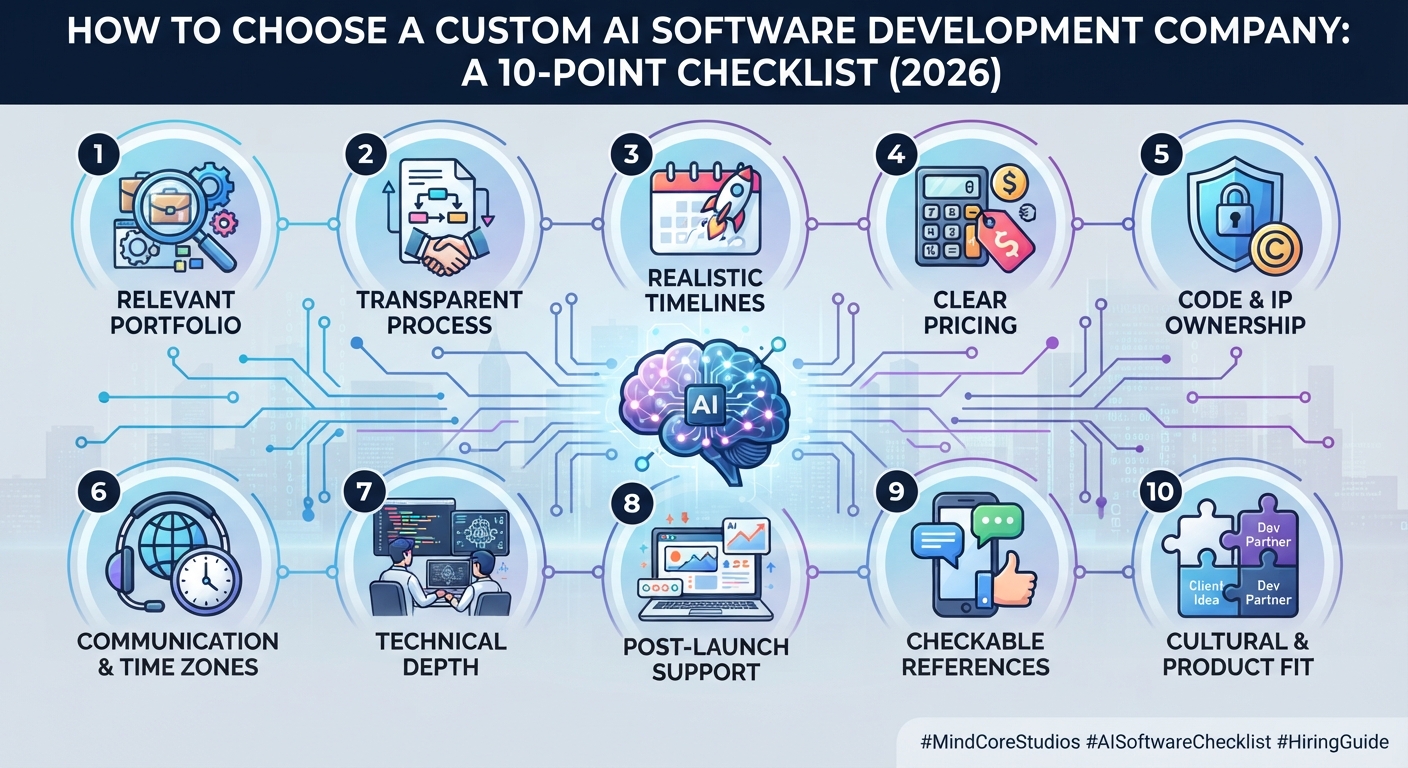
The 10-Point Checklist
Relevant Portfolio Experience
Look past generic case studies. Ask for examples close to your specific need same industry, similar technical complexity, or comparable product stage (pre-seed MVP vs. Series B scale-up are very different builds).
A team that's shipped ten marketing websites isn't automatically equipped to build an AI-powered product, and a team that specializes in enterprise integrations may over-engineer a simple MVP. Ask them to walk you through one project in detail, the problem, the technical decisions, and what they'd do differently in hindsight. Teams with real experience talk about trade-offs. Teams without it talk about features.
What a strong answer sounds like: "We built something similar for a logistics client. Here's what we chose for the architecture, and here's the one decision we'd change if we did it again." What a weak answer sounds like: A list of technologies with no discussion of why they were chosen or what went wrong along the way.
A Transparent, Documented Process
Ask exactly how they run a project: how requirements are gathered, how sprints are structured, how often you'll see progress, and how scope changes are handled.
Vague answers here are a warning sign. A mature team can walk you through their process in five minutes without hesitation, usually pointing to a real artifact: a project board, a sprint calendar, a sample status report rather than describing it in the abstract. If a company can't show you what a typical week of communication looks like, assume it will be worse than you're imagining once the contract is signed.
Realistic Timelines (Not Just Fast Ones)
Fast delivery is valuable, but only if it's honest. Be wary of teams that promise ambitious timelines without asking hard questions about your requirements first; that's usually a sign the estimate was built to win the deal, not to reflect the actual work.
A trustworthy team will ask more questions than they answer in the first conversation. If a company gives you a firm delivery date before understanding your data model, your integrations, or your compliance requirements, treat that number as marketing, not a commitment.
A Clear Pricing Model
Understand whether you're being quoted fixed price, time & materials, or a dedicated team model and, critically, what happens if scope changes mid-project. Ambiguity in pricing almost always turns into disputes later, usually right when you can least afford the distraction.
Ask specifically: What triggers a change order? Who approves it? How is it priced? If the answer is vague or "we'll figure it out," that flexibility will cost you later either in your budget or in your timeline.
Code and IP Ownership
Confirm in writing that you own the source code, the IP, and any custom models or assets built during the engagement. This should be a standard clause, not something you have to negotiate for.
This matters more than most founders realize until it's too late. If you ever want to switch vendors, bring development in-house, or raise funding, unclear IP ownership can become a legal and financial liability during due diligence. Ask for the specific contract language before you sign, not a verbal assurance.
Communication Style and Time Zone Overlap
A brilliant team that's impossible to reach during your working hours will slow you down. Ask how updates are shared async standups, weekly calls, shared dashboards and how much real-time overlap you'll have for urgent conversations.
This isn't just a logistics question; it's a leading indicator of how decisions get made when something goes wrong mid-sprint. Teams with little overlap can still work well, but only if their async communication is genuinely thorough, not a one-line Slack update.
Technical Depth Beyond the Sales Team
Ask to speak directly with the engineers or technical lead who'll actually work on your project, not just the account manager. Their answers to specific technical questions will tell you far more than a polished pitch deck.
This is one of the clearest signals of a company's real capability. Sales teams are trained to sound confident about anything. Engineers, when asked a pointed technical question about your specific use case, will either give you a specific, considered answer or visibly struggle and that difference is hard to fake.
Post-Launch Support
Software isn't done at launch. Ask what support looks like after go-live bug fixes, monitoring, uptime expectations, and how quickly critical issues get addressed. Ask specifically about response-time commitments (SLAs) for production-breaking bugs versus minor issues, and whether ongoing support is included, optional, or a separate contract entirely.
A team that treats launch as the finish line, rather than the start of a maintenance relationship, is a team you'll likely need to replace within a year.
References You Can Actually Call
A confident team will connect you with past clients willing to talk candidly including about what didn't go perfectly. That honesty is a good sign, not a red flag. No project is flawless, and a reference who says "everything was perfect" is often less credible than one who says "here's where we hit friction and how they handled it."
When you get a reference call, ask directly: Would you hire them again? What would you do differently in how you managed the relationship?
Cultural and Product Fit
Beyond the technical checklist, ask whether this team pushes back when your idea has gaps. The right partner should feel like a collaborator invested in the outcome not an order-taker who builds exactly what's written in the brief, even when the brief is wrong.
The best signal here is early friction. If a development team never disagrees with anything in your first few conversations, they're either being agreeable to win the deal or they're not engaging critically with your product. Either way, that's a preview of how the actual engagement will go.
Quick Reference: Pricing Models
| Model | How it works | Best for | Watch out for |
|---|---|---|---|
| Fixed price | One cost for a clearly defined scope | Well-scoped MVPs with stable requirements | Scope creep disputes if requirements shift |
| Time & materials | Billed for actual hours worked | Projects where requirements will evolve | Costs can run higher than expected without active oversight |
| Dedicated team | You pay for a team's ongoing capacity | Long-term, evolving product roadmaps | Requires strong internal product management to direct the team |
Red Flags Worth Walking Away From
- A firm quote or delivery date given before any real discovery conversation
- Reluctance to put code ownership in writing, or vague language around IP
- No direct access to the engineers who'll actually build your product
- References that only include glowing, frictionless praise
- A brief that's simply accepted at face value with no clarifying questions
Frequently Asked Questions
What questions should I ask a software development company before hiring?
Ask about relevant portfolio experience, how their development process works, their pricing model, who owns the code after delivery, and what post-launch support looks like.
How do I know if a software development company is trustworthy?
Trustworthy companies offer transparent, documented processes, connect you with real references, give direct access to their engineers, and put code ownership and pricing terms in writing rather than leaving them ambiguous.
What's the difference between fixed price and time & materials pricing?
Fixed price sets one cost for a clearly defined scope, ideal for well-scoped MVPs. Time & materials bills for actual hours worked, better suited to projects where requirements are expected to evolve.
Do software development companies retain ownership of the code they build?
Reputable companies do not. You should receive full rights to the source code, IP, and any custom assets built during the engagement, confirmed in writing before the project starts.
How long should it take to get a quote from a software development company?
An accurate quote requires a real discovery conversation, not just a form submission. Expect a scoping call before receiving a number — a same-day quote with no questions asked is usually a guess, not an estimate.
What red flags should I watch for when hiring a development company?
Watch for vague answers about process, unrealistic timelines given without asking about requirements, no direct access to engineers, and reluctance to put code ownership or pricing terms in writing.
Should I hire a local or offshore software development company?
Either can work well — the more important factors are time zone overlap for real-time communication, relevant portfolio experience, and a transparent process, regardless of location.