
Most growing businesses eventually hit the same wall: the off-the-shelf tool that worked great at a smaller scale starts creating more problems than it solves. Workarounds pile up. Licensing costs climb with every new hire. And one question becomes impossible to ignore.
Is it time to build something custom?
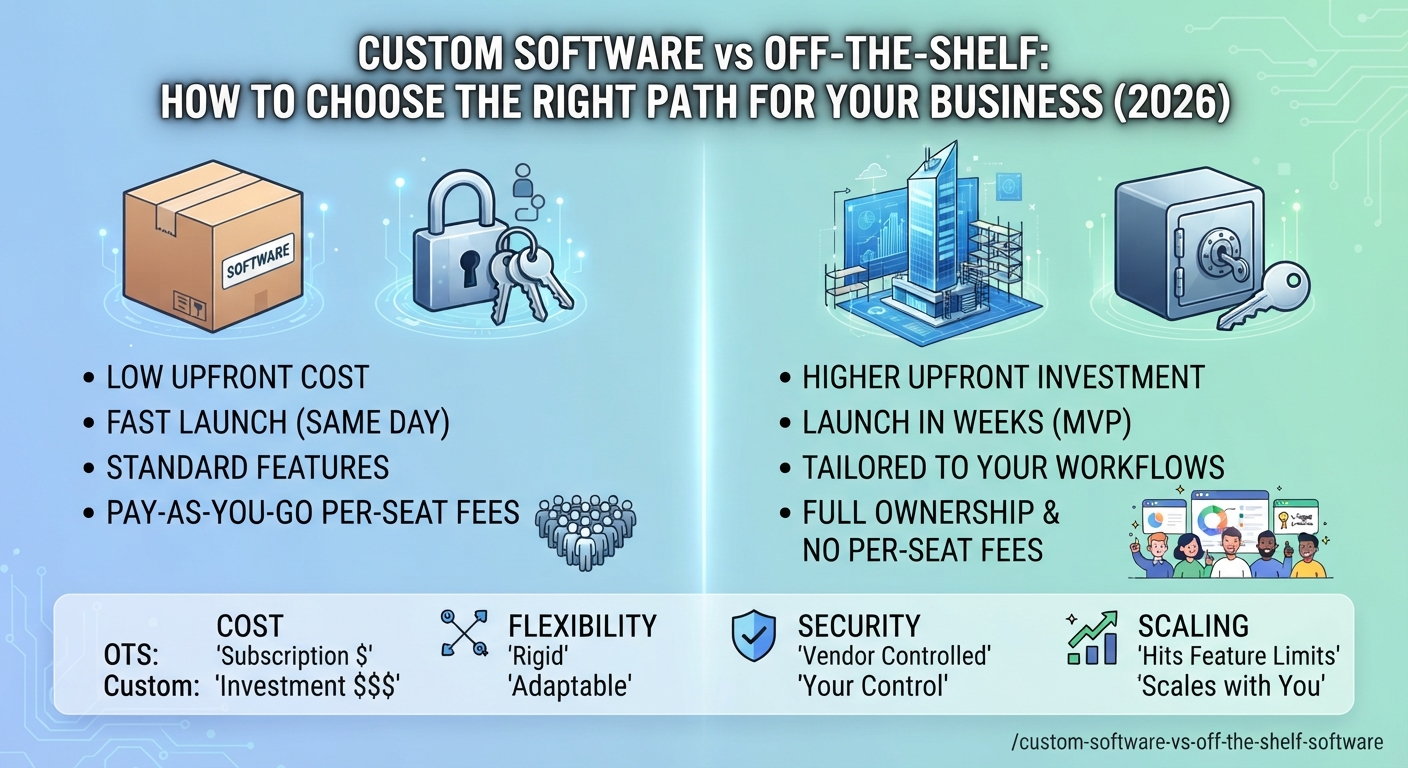
There's no one-size-fits-all answer. But there is a clear way to think it through. Here's how custom and off-the-shelf software actually compare, across the seven factors that matter most.
- Off-the-shelf wins on speed and low upfront cost.
- Custom software wins on fit, control, security, and long-term scalability.
- The right choice depends on how standard your workflow is and how fast you're growing.
What's the Real Difference?
Off-the-shelf software is built once and sold to thousands of businesses with very different needs. That means it's designed for the average use case, not yours specifically.
Custom software is built from the ground up around your exact workflows, data, and users.
That one distinction cascades into almost every other difference between the two: cost, flexibility, ownership, and how well each option scales with you.
Cost: Pay-as-You-Go vs. Own It Outright
| Off-the-Shelf | Custom Software | |
|---|---|---|
| Upfront cost | Low - often just a subscription | Higher - a real investment |
| Ongoing cost | Per-seat or usage-based fees that grow with your team | No recurring per-seat tax |
| Long-term total cost | Can quietly compound over the years | Often flips in your favor over a multi-year horizon |
The takeaway: off-the-shelf is cheaper to start. Custom is often cheaper to scale.
Flexibility and Fit
This is where custom software really pulls ahead.
Packaged tools are built for the average customer so the moment your process is even slightly non-standard, you're stuck with a manual workaround, a spreadsheet duct-taped to the side, or a support ticket to a vendor who may never prioritize your request.
Custom software is built around how you actually work, from day one. No compromises required.
Security and Data Ownership
With off-the-shelf tools, your data lives on someone else's infrastructure governed by their security practices and, like it or not, their breach history.
With custom software, you control the architecture, the integrations, and exactly where your data lives. That's a big deal if you're in a regulated industry or handling sensitive customer data.
Speed to Launch
Off-the-shelf still wins on raw speed; you can be up and running the same day.
But the gap is closing. Traditional custom builds used to take months. With modern, MVP-focused development, a well-scoped custom MVP can now launch in a matter of weeks, not months making "off-the-shelf is faster" less of a slam dunk than it used to be.
Scalability as You Grow
Off-the-shelf tools tend to hit a ceiling feature limits, rate limits, or pricing tiers that make scaling expensive fast.
Custom software is architected around your specific growth trajectory from the start. Scaling becomes an engineering decision you make, not a renegotiation you're forced into with a vendor.
Long-Term Maintenance and Vendor Dependency
With off-the-shelf software, you're tied to the vendor's roadmap, their pricing changes, and even their decision to sunset the product entirely.
With custom software, maintenance is entirely your call. You decide when and how to invest in updates.
So, Which One Should You Choose?
| Choose Off-the-Shelf if... | Choose Custom Software if... |
|---|---|
| Your workflow is genuinely standard | Your process is part of your competitive advantage |
| Budget is tight | You're outgrowing a packaged tool's limits |
| You need something running today | Data ownership and security are non-negotiable |
Not sure yet? Start with a scoped MVP to validate your idea before committing to a full custom build.
Frequently Asked Questions
What's the difference between custom and off-the-shelf software?
Custom software is built specifically for one organization's workflows and data. Off-the-shelf software is a packaged product built for the average business in its category, so you adapt to its structure instead of the other way around.
Is custom software more expensive than off-the-shelf software?
It has a higher upfront cost, but off-the-shelf software carries ongoing per-seat or usage fees that compound over time. Over a multi-year horizon, total cost of ownership often favors custom software for scaling teams.
When should a business choose custom over off-the-shelf?
When your workflow is a competitive advantage, you're outgrowing a packaged tool's limits, or data security and ownership are business-critical.
Can off-the-shelf software be customized later?
Usually but only within limits. Settings, plugins, and paid add-ons can help, but you're still constrained by the vendor's underlying data model and roadmap.
Which is more secure custom or off-the-shelf?
Custom software generally has a stronger security posture, since the architecture, integrations, and data location are chosen deliberately rather than inherited from a generic platform used by thousands of unrelated companies.
How fast can custom software be built compared to off-the-shelf tools?
Off-the-shelf tools can go live the same day. Custom software traditionally takes longer, but a well-scoped MVP can now launch in as little as 15 days closing the speed gap considerably.
Can I switch from off-the-shelf to custom software later?
Yes. Many businesses start on an off-the-shelf tool and migrate to custom software once their workflow outgrows the platform. The main things to plan for are data migration and integration.